


India's CRGO Crossroads: Can Domestic Production Keep Pace With a Nation Running Out of Room to Import?

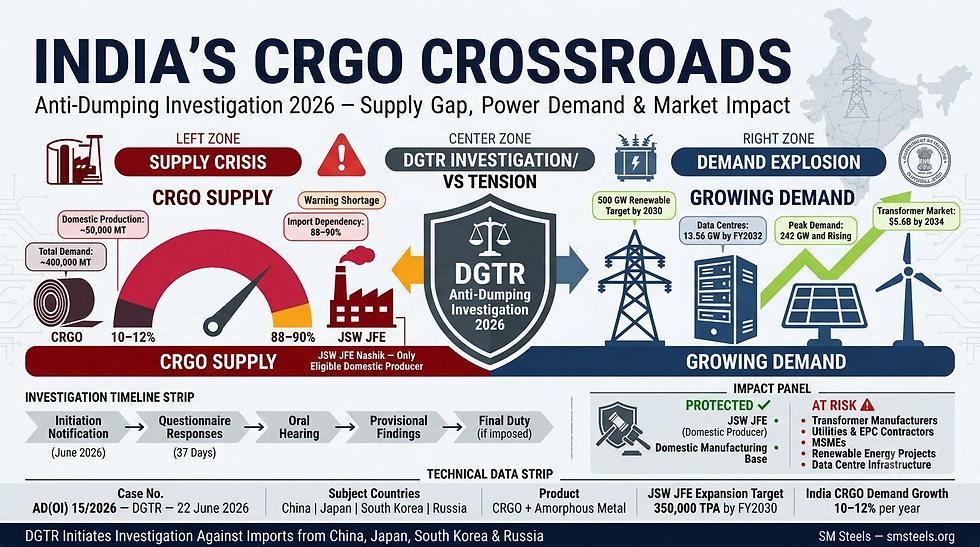
A DGTR anti-dumping investigation has been initiated against CRGO and Amorphous Metal imports from China, Japan, South Korea, and Russia — at the exact moment India needs more of this material than at any point in its history.
The Timing Could Not Be More Consequential
On 22 June 2026, India's Directorate General of Trade Remedies (DGTR) issued F. No. 6/17/2026-DGTR: an initiation notification for an anti-dumping investigation into imports of Cold Rolled Grain Oriented Electrical Steel (CRGO) and Amorphous Metal (AM) originating in or exported from China PR, Japan, Korea RP, and Russia. Case No. AD(OI) 15/2026 was registered on the SETU portal under Case Id AD/OI/016/2026.
The application was filed by JSW JFE Electrical Steel Private Limited India's only domestically eligible CRGO producer which alleged that dumped imports from these four countries are causing material injury to domestic industry. The DGTR, upon prima facie review, found sufficient evidence of dumping and injury to initiate the investigation. A Period of Investigation (POI) of 1 April 2025 to 31 March 2026 has been defined, with an injury investigation period extending back to 1 April 2022.
This is not yet a duty. It is an initiation notification the first formal step in a process that can take six to twelve months before any provisional or final anti-dumping duty is imposed. The investigation is live, not concluded.
But the market does not wait for final findings. The announcement alone is already reshaping procurement behaviour, supplier conversations, and price expectations across India's transformer supply chain.
The critical question is not whether India has the right to protect domestic industry. It does. The more important question is this: Can India's CRGO ecosystem as it stands today and as it is projected to stand over the next five years support the scale of demand that the country's power sector, renewable energy infrastructure, AI data centres, and industrial expansion will require? The data demands an honest answer.
What the DGTR Notification Actually Says
India's anti-dumping framework is governed by the Customs Tariff Act, 1975, and the Customs Tariff (Identification, Assessment and Collection of Anti-Dumping Duty on Dumped Articles for Determination of Injury) Rules, 1995. The initiation notification is a procedural step that triggers a formal investigation. It does not impose duty.
Key factual details from the notification are as follows. The applicant is JSW JFE Electrical Steel Nashik Private Limited. The subject countries are China PR, Japan, Korea RP, and Russia. The European Union was initially proposed but excluded after the DGTR found a negative prima facie injury margin specific to EU imports. Products under investigation cover CRGO (silicon content between 0.6% and 6%) and Amorphous Metal (AM) a non-crystalline alloy used as a direct commercial substitute for CRGO transformer cores classified under tariff items 7225 1100, 7226 1100, 7226 9930, and related HS codes. Both materials are used for manufacturing power and distribution transformer cores. The POI runs from 1 April 2025 to 31 March 2026.
The DGTR confirmed that NLMK India Coating Pvt. Ltd. the only other producer of CRGO in India is not eligible to be treated as part of the domestic industry for this investigation. NLMK India is related to Russian producers and is also an importer of the subject goods, disqualifying it under Rule 2(b) of the AD Rules. This means JSW JFE Electrical Steel Nashik Private Limited is the sole eligible domestic industry for the purpose of this investigation.
On normal value, China is treated as a non-market economy. For China, the applicant could not obtain reliable third-country market data and therefore constructed normal value based on India's cost of production plus reasonable profit. For Japan, Korea, and Russia, the applicant similarly lacked reliable public comparable price data and applied the same cost-of-production construction methodology. The applicant has prima facie demonstrated that the dumping margin is above the de minimis threshold across all four subject countries.
The applicant has also requested retrospective imposition of anti-dumping duties for up to 90 days prior to any provisional duty, citing a history of dumping, importer awareness of dumping practices, and a steep decline in domestic industry performance during the POI.
The DGTR has not yet issued provisional or final findings. Any interested party exporters, importers, foreign governments, or users of the product has 37 days from the date on which the non-confidential version of the application is circulated to file questionnaire responses through the SETU portal (Case ID: AD/OI/016/2026).
Why CRGO Is Not an Ordinary Steel Product
CRGO is not a commodity. It is a precision-engineered material that requires secondary recrystallization furnaces, ultra-precise cold rolling equipment, and coating technology that only a small number of manufacturers worldwide have mastered. Its defining physical property grain orientation allows it to conduct magnetic flux with exceptionally low energy loss, which is why transformer cores made from CRGO are significantly more efficient than those made from ordinary electrical steel.
Every power transformer in India's grid contains a CRGO or AM core. Every distribution transformer that steps down voltage from the transmission line to your industrial facility or residential colony uses this material. Every substation upgrading from 220 kV to 400 kV or 765 kV that India is building to evacuate solar and wind power from Rajasthan or Tamil Nadu requires transformers with CRGO or AM cores. There is no substitute for this material in high-efficiency transformer manufacturing.
The Bureau of Energy Efficiency's January 2025 mandate requiring an upgrade in star-label ratings for distribution transformers has intensified this reality further. Transformer manufacturers that want BEE star-rated products must move toward higher-grade CRGO specifically HiB (High Permeability) grades because the energy loss targets cannot be met with conventional M-grade CRGO. This has created a dual demand problem: total volume is rising, and the grade specification is tightening simultaneously.
The Supply Arithmetic India Cannot Escape
The numbers are not comfortable, and they have been consistent across every credible source for the past two years. India's annual CRGO demand in FY 2023–24 stood at approximately 400,000 metric tonnes. Domestic production exclusively from the JSW JFE Electrical Steel Nashik facility contributed approximately 50,000 metric tonnes, representing 10 to 12 percent of total demand. India imported 239,200 metric tonnes from China, Japan, Russia, and South Korea. After accounting for 11,400 metric tonnes of exports, approximately 277,800 metric tonnes were available for domestic use leaving a structural shortfall of 122,200 metric tonnes, or 30.6 percent of total demand. This figure was documented and verified by the Global Trade Research Initiative (GTRI) in their December 2024 report, covered by Business Standard, BW Businessworld, KNN India, and Outlook Business.
Metric | FY 2023–24 | Source |
Total CRGO Demand (India) | ~400,000 MT | GTRI / Business Standard, Oct 2024 |
Domestic Production | ~50,000 MT | JSW JFE Nashik / Industry Reports |
Total Imports | 239,200 MT | GTRI / KNN India |
Exports from India | 11,400 MT | GTRI |
Net Domestic Availability | 277,800 MT | GTRI Calculation |
Structural Shortfall | 122,200 MT (30.6%) | GTRI / BW Businessworld |
Import Dependency Ratio | ~88–90% | Fastmarkets / Industry Analysis |
Fastmarkets, in its October 2025 launch of the electrical steel CFR India price assessment (MB-STE-0941), confirmed that India imports close to 400,000 tonnes annually against domestic production of approximately 40,000 to 50,000 tonnes describing the supply gap as representing a 90.9% import dependency ratio that fundamentally shapes market pricing dynamics, making Indian buyers price-takers in the global CRGO market. India's CRGO demand is projected to grow at 10 to 12 percent annually through 2030, driven by the expanding power sector, the renewable energy integration target of 500 GW, the BEE efficiency mandate, industrial expansion, data centre infrastructure, and EV charging networks. At 10 percent annual growth, India's CRGO demand would reach approximately 640,000 to 650,000 metric tonnes per year by FY 2029–30. At 12 percent annual growth, the figure approaches 700,000 metric tonnes.
India today cannot meet its CRGO demand without imports. And at the current trajectory of domestic capacity expansion, it will not be able to meet its CRGO demand without imports for at least the next three to four years even with JSW JFE's announced expansion programme.
JSW JFE: The Expansion That Changes Everything Eventually
JSW JFE Electrical Steel is undertaking the single most significant investment in India's CRGO manufacturing history. The facts are well-documented and publicly confirmed.
The Nashik facility acquired by JSW JFE from thyssenkrupp Electrical Steel India Private Limited in January 2025 for approximately ₹4,159 crore currently operates at 50,000 TPA capacity. The board has approved an expansion to 250,000 TPA. John Cockerill India Limited was awarded the contract in September 2025 for the engineering, design, manufacture, and supply of high-temperature tunnel furnaces for the Nashik facility, with commissioning targeted for the first quarter of 2027. The full expansion of Nashik from 50,000 TPA to 250,000 TPA will begin in FY 2028 and is expected to complete in phases through FY 2030.
Separately, JSW JFE Electrical Steel Private Limited's Vijayanagar, Karnataka facility a greenfield plant established in February 2024 has had its planned capacity doubled from an initial 62,000 TPA to 100,000 TPA, with full production expected to commence in 2027. Total investment across both sites: approximately ₹6,500 crore (JPY 120 billion), with cumulative JSW JFE investment in India reaching approximately JPY 290 billion roughly ₹17,000 crore or USD 2 billion.
Facility | Current Capacity | Target Capacity | Expected Timeline |
JSW JFE Nashik (Maharashtra) | 50,000 TPA | 250,000 TPA | Expansion: FY2028–FY2030 (phased) |
JSW JFE Vijayanagar (Karnataka) | Under construction | 100,000 TPA | Full production: 2027 |
Combined Capacity (Post-Expansion) | 50,000 TPA | 350,000 TPA | Full realisation: FY2030 |
At 350,000 TPA post-expansion, JSW JFE's combined capacity would cover approximately 50 to 55 percent of India's current annual demand of 400,000 metric tonnes but by the time that capacity is fully realised in FY 2030, India's annual demand will likely have grown to 600,000 to 700,000 metric tonnes, depending on the growth rate. The supply gap will still exist; it will simply be narrower.
This is the core structural reality: JSW JFE's expansion is essential, ambitious, and welcome. It is also not sufficient to make India self-sufficient in CRGO, and it will not be complete for several years. The period 2026 to 2030 is precisely the most critical window when demand is accelerating fastest and it is the window during which India remains most import-dependent.
India's Power Demand: The Scale of What Is Coming
The CRGO anti-dumping investigation is unfolding against a backdrop of extraordinary power sector expansion one that has few global parallels in scale or speed.
India's peak electricity demand reached 242.49 GW in FY 2025–26, confirmed by the Ministry of Power in its Year End Review of December 2025. The IEA's Electricity 2026 report projects Indian electricity consumption to grow at an average of 6.4 percent per year through 2030, adding 570 terawatt-hours (TWh) to annual consumption over the five-year period. The Central Electricity Authority projects peak demand to exceed 459 GW by 2035–36. India's installed capacity needs to reach and likely exceed 1,000 GW by 2034–35, as confirmed by CEA Chairman Ghanshyam Prasad in August 2025.
The transmission infrastructure required to support this demand is similarly extraordinary. India must construct approximately 335 GW of transmission network to connect 280 GW of variable renewable energy to the Inter-State Transmission System (ISTS) by 2030. As of the Ministry of Power's December 2025 review, 48 GW of this had been completed, 172 GW was under construction, and 18.5 GW was under bidding. The Ministry approved 25.8 GW of RE-linked interstate transmission projects worth ₹38,849 crore in 2025 alone.
Every kilometre of this transmission expansion every new substation, every step-up and step-down transformer, every new 400 kV and 765 kV yard requires CRGO or AM steel. India added 113,013 MVA of substation transformation capacity at 220 kV and above in FY 2025–26, achieving 90 percent of its 126,007 MVA target. The India transformer market, valued at approximately USD 2.6 billion in 2025, is projected to reach USD 5.6 billion by 2034 a CAGR of 7.76 percent.
India's government has committed ₹25.7 lakh crore (USD 300 billion) to power and transmission infrastructure through 2030. Every rupee of that commitment requires transformers. Every transformer requires CRGO or AM. The math is not subtle.
Data Centres: The Demand Driver Nobody Planned For
When India's transformer industry drew up its demand forecasts five years ago, data centres were not among the primary growth drivers. They are now, and the numbers are staggering.
India's operational data centre capacity reached approximately 1,520 MW IT by the end of 2025, representing a 34 percent increase over the previous year, according to Savills India data. Mumbai accounted for 34 percent of operational supply, Delhi-NCR 20 percent, and Chennai 19 percent. The sector absorbed approximately 430 MW of new capacity in 2025 alone. India's installed data centre capacity is projected to reach 1.7 to 2.0 GW by the end of 2026, backed by nearly USD 30 billion in investments (Vestian, April 2026).
The pipeline beyond 2026 is larger still. Over USD 60 to 70 billion in data centre projects have been announced for the next five years, led by hyperscale platforms and joint ventures. Mordor Intelligence projects India's total data centre capacity to climb from 5,450 MW in 2026 to 15,210 MW by 2031 a CAGR of 22.79 percent. AI-driven infrastructure accounted for 78 percent of data centre leasing activity in 2025, compared with just 23 percent a year earlier. Google and Adani finalised a USD 15 billion alliance in October 2025 for cloud regions in Bengaluru, Delhi-NCR, and Mumbai. NTT DATA and Neysa Networks signed an MoU with the Telangana government in April 2025 to invest USD 1.18 billion in a 400 MW AI-driven data centre cluster in Hyderabad.
Power demand from AI data centres in India could hit 50 TWh a year by 2030. The Ministry of Power has projected that power demand from data centres will reach approximately 13.56 GW by FY 2031–32. Karnataka's Department of Energy has already announced plans to upgrade transmission lines from 400 kV to 765 kV specifically to support data centre power loads.
Every large-scale hyperscale facility a 100 MW campus is effectively its own mini-grid infrastructure project. It requires transformers. Those transformers require CRGO.
India is building a digital economy that will rank among the world's largest within a decade. That digital economy runs on power. That power flows through transformers. Those transformers need CRGO that India cannot yet produce in sufficient quantity and the government has now initiated an investigation that could make importing it more expensive.
Renewable Energy: 500 GW Ambition, One Material Constraint
India's target of 500 GW of non-fossil fuel capacity by 2030 is one of the most ambitious energy commitments made by any nation in history. As of December 2025, India's total renewable energy capacity including large hydroelectric had reached 258.3 GW, with solar contributing 135.81 GW and wind 54.51 GW. Between April and December 2025, India added a record 37.91 GW of renewable capacity, surpassing fossil fuels in total clean energy capacity for the first time.
The IEA projects India will add approximately 300 GW of new renewable capacity between 2025 and 2030 roughly 60 GW per year on average. The CEA's adequacy plan projects solar to grow from approximately 141 GW in 2025–26 to 509 GW by 2035–36, wind from 55 GW to 155 GW. As of March 2026, approximately 157.80 GW of renewable energy capacity was under construction.
This renewable expansion drives transformer demand across three separate stages: generation-side transformers at solar and wind farms that step up voltage for grid injection; transmission-side power transformers at evacuation substations; and distribution-side transformers at the load end. Power Grid Corporation of India placed an order in June 2025 with Hitachi Energy India for 30 units of 765 kV 500 MVA single-phase transformers. GE Vernova was selected in May 2025 to supply over 70 extra-high-voltage transformers and shunt reactors for Power Grid's major transmission projects. Every one of these units contains CRGO or AM at its core.
The Anti-Dumping Investigation Through an Honest Lens
Let us be direct about what this investigation represents and what it does not.
JSW JFE Electrical Steel Nashik Private Limited is the sole eligible applicant in this investigation and it is simultaneously the company that filed the anti-dumping complaint, the company receiving the largest foreign investment in India's CRGO manufacturing history, and the company whose capacity currently meets 10 to 12 percent of India's CRGO demand. Its Nashik expansion will not reach full capacity until FY 2030 at the earliest. Its Vijayanagar facility will begin full production in 2027. Between now and then, India remains almost entirely import-dependent for CRGO.
The anti-dumping rules entitle JSW JFE to file this application. The DGTR was correct to initiate the investigation upon finding prima facie evidence of dumping and injury. These are legally grounded steps. None of this is in dispute.
What is in dispute is the question of market consequence. Anti-dumping duties, if imposed, function as a price floor on imports. In a market where domestic supply covers 10 to 12 percent of demand and the remaining 88 to 90 percent must be imported, a price floor on imports is not industrial protection in any meaningful sense it is a cost increase imposed on transformer manufacturers, utilities, renewable energy developers, EPC contractors, and ultimately the industrial and residential consumers who pay electricity tariffs. There is no domestic alternative they can switch to. There is no volume of domestic CRGO that makes the imported volumes optional. The import is structurally required.
To put it plainly: India is attempting to protect a domestic industry that cannot supply its own market, by making the imports that supply its market more expensive, at the precise moment when demand is growing at its fastest rate in history.
This is not a critique of JSW JFE, which is making a legitimate and essential investment. It is a question about timing, sequencing, and the burden that the investigation itself even before any duty is imposed places on an already-strained supply chain.
The GTRI's December 2024 report specifically recommended that India must prioritise local production, that the BIS process needs urgent review by independent auditors, and that the approved list of CRGO grades and suppliers must be expanded to support smaller manufacturers and MSMEs not restricted further. The report did not recommend restricting imports. It recommended closing the supply gap from the domestic side, not the import side.
Market Impact: Who Bears the Cost?
The transformer manufacturing industry in India is highly sensitive to input material costs. CRGO and copper together account for up to 70 percent of a transformer's production cost. Annual price swings of 25 to 30 percent on global exchanges for these materials have already pressured margins significantly in recent cycles. Anti-dumping duties, if imposed, would represent an additional and durable cost increase on top of existing price volatility.
Transformer Manufacturers
Large transformer manufacturers ABB India, Hitachi Energy India, BHEL, Transformers and Rectifiers India, Toshiba TTDI, Indo Tech Transformers procure CRGO in volume and have greater capacity to absorb cost increases or renegotiate procurement contracts. Smaller and mid-size manufacturers do not. Any anti-dumping duty will compress their margins further or force price increases to utilities and EPC customers, who may in turn delay procurement.
Utilities and EPC Contractors
Public utilities DISCOMs, transmission utilities, Power Grid Corporation of India procure transformers through tendering processes. Tender prices are negotiated in advance. If anti-dumping duties push transformer input costs up, either the tender prices rise at the next cycle or manufacturers absorb the cost and reduce investment. Neither outcome is costless for the power sector's expansion timeline.
SMEs and MSMEs
The GTRI report specifically identified small and medium enterprises as the most vulnerable segment. MSMEs in India's transformer component supply chain typically purchase CRGO in smaller quantities at spot or short-term rates, with limited ability to forward-hedge. For this segment, even the uncertainty created by an active anti-dumping investigation before any duty is imposed has been sufficient to trigger procurement uncertainty, lead-time extensions, and spot-price premium anxiety.
Importers, Traders, and Distributors
The trader and distributor segment faces the most immediate uncertainty. Importers with shipments in transit or goods contracted for delivery face the possibility of retrospective duty a specific request made by the applicant for up to 90 days retroactive to provisional duty. Any importer, trader, or distributor operating in this market must account for this risk from this week forward.
Three Scenarios: What Could Happen Next
Scenario 1 Investigation Concludes Without Duty
The DGTR investigation finds insufficient final injury or causal link, or finds that dumping margins are below actionable thresholds. No anti-dumping duty is imposed. The investigation resolves without market disruption beyond the period of uncertainty. This is possible, given that the injury period also covers a time when BIS licence disruptions caused artificial supply tightness a supply-side problem that can be distinguished from dumping injury.
Scenario 2 Provisional Duty Within 6 Months
The investigation progresses and the DGTR issues a recommendation for provisional anti-dumping duty within six months of initiation. Duties are imposed on a product-category and country-specific basis. The market experiences immediate import cost increases, pricing volatility, and procurement disruption. The duty period is typically five years from final imposition. This scenario creates a high-cost operating environment for the transformer industry during the exact years when India's power sector is growing fastest.
Scenario 3 Investigation Triggers Strategic Realignment
A more constructive outcome: the investigation process itself creates conditions for a strategic government intervention an accelerated domestic capacity expansion roadmap, a PLI enhancement for CRGO manufacturing, or a parallel policy framework that pairs the anti-dumping investigation with a supply development commitment. This would acknowledge the domestic industry's legitimate injury claims while also protecting the transformer industry's competitiveness. This is the scenario that would serve India's long-term interests most effectively.
The right question for Indian policymakers is not simply whether imports were dumped that is the DGTR's question to answer. The right question is: How does India build a secure CRGO supply ecosystem that supports both domestic manufacturing and transformer industry growth simultaneously? Those two objectives are not inherently in conflict but the current investigation creates a real risk that short-term trade protection undermines long-term energy infrastructure development.
What Industry Participants Should Do Now
Transformer manufacturers, EPC contractors, utilities, importers, and traders should all be taking specific actions in the coming weeks, regardless of where the investigation leads.
Every importer, distributor, and buyer of CRGO or AM from China, Japan, South Korea, or Russia should review their open contracts, contracted volumes, and consignment positions. Retrospective duty exposure on 90 days prior to any provisional duty is a live risk. Interested parties may register on the SETU portal under Case ID AD/OI/016/2026 and have 37 days from notification circulation to file responses.
Procurement strategies should be reviewed now. Buyers with existing quarterly supply agreements from subject countries should understand their cost exposure under different duty scenarios before those scenarios materialise. Forward contracts and supply agreements that do not account for potential duty imposition carry significant financial risk.
Supplier diversification is a medium-term priority that has become an immediate consideration. While Europe was excluded from this investigation, European CRGO volumes are limited and typically priced at a premium. Indian buyers should be actively mapping supply relationships beyond the four subject countries including emerging sources in Taiwan and the domestic supply ramp-up timelines from JSW JFE.
Transformer manufacturers should document the impact of CRGO cost changes on their tendering positions and actively communicate with utility customers about potential price revision mechanisms if duties are imposed.
Frequently Asked Questions
Is this an anti-dumping duty?
No. This is an initiation of an anti-dumping investigation. The DGTR has found prima facie evidence to investigate it has not yet imposed any duty. The investigation is expected to run for up to twelve months before final findings are issued.
Which countries are under investigation?
China PR, Japan, Korea RP (South Korea), and Russia. The European Union was proposed but excluded at initiation after a negative prima facie injury margin was observed for EU imports.
Who filed the complaint?
JSW JFE Electrical Steel Nashik Private Limited India's only eligible domestic CRGO producer for the purposes of this investigation. NLMK India Coating Pvt. Ltd. was found ineligible due to its relationship with Russian producers and importers.
What products are covered?
Cold Rolled Grain Oriented Electrical Steel (CRGO) and Amorphous Metal (AM) used for electrical transformer cores, measured in metric tonnes or kilograms. Amorphous Metal used for non-transformer purposes and Magnesium Oxide (MgO) coated cold-rolled steel coils for CRGO substrate are excluded.
Could duties be applied retroactively?
The applicant has requested retrospective anti-dumping duty for up to 90 days prior to any provisional duty. The DGTR will consider this request. This means shipments currently in transit could theoretically be subject to retrospective duty if the investigation progresses to a provisional duty recommendation.
Can India meet its CRGO demand without imports from these four countries?
No not now, not over the next two to three years. India's domestic production covers 10 to 12 percent of demand. The four subject countries China, Japan, South Korea, and Russia are India's primary CRGO import sources. There is no combination of alternative suppliers that can substitute these volumes at equivalent quality and price within the investigation or duty period.
How will this affect transformer prices in India?
If anti-dumping duties are imposed, CRGO input costs for transformer manufacturers will increase. Since CRGO and copper together constitute up to 70 percent of transformer production costs, any material CRGO price increase will flow through to transformer prices in subsequent procurement cycles. The degree of impact will depend on the duty rate, the specific countries affected, and whether provisional measures are applied.
How does this affect the BEE star-label mandate?
The BEE star-label upgrade for distribution transformers, effective January 2025, requires higher-grade CRGO specifically HiB grades to meet lower energy loss targets. If imports become more expensive or more uncertain, manufacturers may face increased difficulty sourcing the specific high-grade CRGO needed for BEE-compliant products.
When will JSW JFE's Vijayanagar plant be ready?
Full production at the Vijayanagar, Karnataka facility is expected by 2027, at 100,000 TPA capacity. The Nashik expansion from 50,000 TPA to 250,000 TPA begins in FY 2028 and completes in phases through FY 2030. Combined capacity at full build-out: 350,000 TPA.
What should a CRGO buyer or importer do right now?
Register as an interested party on the SETU portal (https://setu.dgtr.gov.in) under Case ID AD/OI/016/2026. File questionnaire responses within 37 days of notification. Review open contracts for retrospective duty exposure. Map alternative supply sources. Consult legal counsel on compliance obligations under the investigation timeline.
Conclusion: A Critical Question India Must Answer
India's ambition to build a robust domestic electrical steel manufacturing ecosystem is strategically sound and long overdue. CRGO has been a persistent supply vulnerability for India for five decades. JSW JFE's investment the largest commitment to CRGO manufacturing in India's history represents genuine and welcome progress toward addressing that vulnerability.
The DGTR investigation follows established legal procedures and the applicant's claims of dumping injury are within the framework of legitimate trade defence. The process is legally sound.
But sound process does not automatically produce sound outcomes. India is attempting to defend a domestic industry that currently supplies 10 to 12 percent of its own market by increasing the cost of the 88 to 90 percent that must come from abroad during a period when electricity demand is growing at 6.4 percent annually, when renewable energy addition targets require thousands of new transformers per year, when data centre power demand is projected to exceed 13 GW by FY 2031–32, and when the domestic expansion that would justify supply restriction will not be complete until FY 2030.
The trade-off is real. If anti-dumping duties are imposed, transformer manufacturers face higher input costs. Utilities face higher procurement costs. Renewable energy projects face longer supply lead times. MSMEs face existential margin pressure. Data centre operators face substation infrastructure delays. The cost of electricity India's primary development infrastructure will increase at the margin.
These costs would be reasonable if domestic supply could absorb the demand that displaced imports leave behind. It cannot. Not yet. And that is the central problem with the timing of this investigation.
India deserves the strongest possible domestic CRGO manufacturing base. Building that base requires investment, time, and strategic patience not a trade barrier that arrives before the capacity exists to make it viable. The question the government must answer is whether it is protecting an industry or protecting a supply chain. Right now, those are not the same thing.
S M Steels will continue to monitor the progress of Case No. AD(OI) 15/2026 and provide market updates as provisional findings, oral hearing schedules, and disclosure statements are issued by the DGTR.
References
1. DGTR Initiation Notification F. No. 6/17/2026-DGTR, Case No. AD(OI) 15/2026, dated 22 June 2026 dgtr.gov.in
2. GTRI Report on CRGO Steel Shortage, December 2024 Global Trade Research Initiative
3. Business Standard: "CRGO steel shortage could impact India's power sector expansion plans: GTRI" October 28, 2024
4. JFE Steel Corporation Press Release: "Expansion of Electrical Steel Manufacturing Capacity in India" August 4, 2025 jfe-steel.co.jp
6. IEA Electricity 2026 Report February 2026 iea.org
7. Ministry of Power Year End Review 2025 December 2025 pib.gov.in
8. Fastmarkets: Launch of Electrical Steel CFR India Price Assessment (MB-STE-0941) October 3, 2025 fastmarkets.com
9. Vestian Report on India Data Centre Capacity April 2026 businesstoday.in
10. Power Line Magazine: "Demand Surge: Key Trends and Outlook for the Transformer Industry" May 2026 powerline.net.in
11. Mordor Intelligence: India Transformer Market Report 2025–2034
12. CEA Resource Adequacy Plan Central Electricity Authority cea.nic.in
13. KNN India: "India Faces 30% Shortage of CRGO Steel" October 2024


Comments