


CRGO Full Form, Meaning & Why It Matters for Transformers in India


Quick Answer: What Is the Full Form of CRGO?
CRGO stands for Cold Rolled Grain Oriented.
Full form broken down:
C — Cold Rolled (manufacturing process)
R — Rolled (the physical action applied to the steel)
G — Grain Oriented (the crystalline structure deliberately aligned)
O — (part of "Oriented")
CRGO is a specialised type of electrical steel — a silicon-iron alloy — engineered so that its internal grain structure is precisely aligned in one direction. This alignment is not accidental. It is achieved through a highly controlled manufacturing process and is the reason CRGO performs at a level that no other steel can match inside a transformer core.
In India's power infrastructure, CRGO core material is the single most critical raw input inside every transformer — from the small 25 kVA distribution unit at the end of your street to the 500 MVA power transformers anchoring high-voltage substations across the national grid.
Table of Contents
1. CRGO Full Form — Word by Word Explained
C — Cold
"Cold" refers to the temperature at which the steel is rolled during manufacturing. Cold rolling is done at or near room temperature — below the steel's recrystallisation temperature. This is in contrast to hot rolling, which occurs at temperatures exceeding 1,100°C.
Why does cold rolling matter? Because rolling steel cold allows for extreme precision in thickness control — down to fractions of a millimetre — and, critically, it is the mechanical force of cold rolling that begins the process of aligning the internal grain structure of the steel in a preferred direction.
R — Rolled
Rolling means passing the steel through a series of progressively narrower rollers to reduce its thickness. For CRGO, this is done in carefully controlled stages, with intermediate annealing (heat treatment) steps between passes. The rolling direction is paramount — it becomes the direction of "easy magnetisation" in the finished product.
G — Grain
"Grain" in metallurgy refers to the individual crystals that make up the microstructure of a metal. Steel, like all metals, is polycrystalline — it consists of millions of microscopic crystalline regions called grains. In ordinary steel, these grains are oriented randomly in all directions.
In CRGO steel, the grains are not random. They are aligned with extraordinary precision in a specific crystallographic direction — the [001] direction, known as the "easy axis" of magnetisation in iron-silicon alloys.
O — Oriented
"Oriented" means the grains have a preferred, deliberate direction — specifically the Goss texture, denoted {110}<001> in crystallographic notation. In practical terms, this means that if you imagine each grain as a tiny compass, in CRGO steel, all those compasses point in approximately the same direction — aligned with the rolling direction of the sheet.
This alignment is what makes CRGO extraordinary. Magnetic flux — the invisible force that makes a transformer work — flows most efficiently along the easy axis of iron crystals. By aligning those crystals, CRGO gives magnetic flux a perfectly aligned highway to travel, reducing resistance (called reluctance) and therefore minimising energy loss.
2. The History of CRGO — How It Was Discovered
The story of CRGO begins not in a transformer factory, but in a research laboratory in the early 1930s.
The Problem That Existed Before CRGO
Before CRGO was developed, transformer cores were made from hot-rolled silicon steel. This material was a significant improvement over plain iron, but it had a fundamental limitation: its grains were randomly oriented. Magnetic flux had to fight its way through a chaotic crystalline landscape, losing energy as heat in the process. Transformer efficiencies were meaningful but not optimal. Engineers knew they were leaving performance on the table.
Norman P. Goss and the 1934 Discovery
In 1933–1934, an American metallurgist named Norman P. Goss made a discovery that would permanently transform electrical engineering. Goss discovered that by applying specific cold rolling and annealing techniques to silicon steel, he could force the grains to align in a preferred crystallographic orientation — the {110}<001> orientation that now bears his name: the Goss texture.
His landmark paper, published in 1934, described how this texture dramatically improved magnetic properties along the rolling direction. The material he created was the first true Cold Rolled Grain Oriented steel.
Goss himself noted in his writings: "I have experimental evidence which leads me to believe that there is an apparent relation between the grain size and ductility of a specimen and its magnetic properties."
This was a foundational understatement. What he had actually discovered was the basis for all modern transformer core technology.
Commercial Adoption: 1940s–1960s
CRGO steel was first commercially applied to transformer cores in the 1940s. By the 1950s, it had largely replaced hot-rolled silicon steel in large transformer applications. By the 1960s, more advanced grades — M5, M4, and M3 — were developed, enabling thinner laminations, lower core losses, and progressively more efficient transformers. By 1995, CRGO had become the universal global standard for transformer cores.
3. What Is CRGO Steel? The Science, Simply Explained
For the Non-Engineer: An Analogy
Imagine you're trying to push a crowd of people through a doorway. If the crowd is facing in random directions, they bump into each other, create friction, and moving them is difficult and wasteful. Now imagine everyone is facing the same direction, aligned, moving together. The same force moves the same crowd with far less effort.
CRGO steel does this with magnetic energy. The "crowd" is the magnetic domains inside the steel. In ordinary steel, these domains point in random directions. CRGO aligns them along the rolling direction, so magnetic flux — the energy a transformer uses to convert electrical power — moves through the steel with dramatically less resistance and loss.
For the Technical Reader: The Physics
CRGO is an iron-silicon alloy with a silicon content of approximately 3.0–3.25% by weight. The silicon serves a critical function: it increases the electrical resistivity of the steel, which directly reduces eddy current losses (explained in Section 8).
The key to CRGO's performance is its Goss texture — the {110}<001> crystallographic orientation. In this structure:
The {110} plane lies parallel to the rolling plane (the surface of the sheet)
The <001> direction — the "easy axis" of magnetisation in body-centred cubic iron — lies parallel to the rolling direction
This means magnetic flux, when directed along the rolling direction, encounters the minimum possible magnetic reluctance. The result is:
High magnetic permeability along the rolling direction (magnetic flux flows easily)
Low hysteresis loss (less energy wasted in each magnetisation cycle)
Low eddy current loss (high silicon content raises resistivity)
Reduced magnetostriction (less dimensional change under magnetisation, which means quieter transformers)
The stacking factor — the ratio of actual steel to total core volume when laminations are assembled — typically ranges from 96% to 97% depending on grade, meaning very little space is wasted in the assembled core.
4. How CRGO Is Manufactured — Step by Step
CRGO manufacturing is one of the most technically demanding processes in the steel industry. There are only a handful of facilities in the world capable of producing it, primarily in Japan, South Korea, Germany, Russia, and China. This concentration of production capability is at the core of India's supply chain vulnerability (discussed in Section 13).
Step 1: Raw Material Preparation
The process begins with very pure iron and precise quantities of silicon, along with trace elements that aid in grain growth control. The target silicon content is approximately 3.0–3.25% — high enough to maximise resistivity, but below ~3.5%, beyond which the steel becomes too brittle for cold rolling.
Step 2: Hot Rolling
The steel is cast into slabs and hot-rolled at temperatures above 1,100°C to produce a hot band — typically 2–2.5 mm thick. This hot band is the starting material for cold rolling.
Step 3: Normalising Anneal
The hot band is annealed (heated and slowly cooled) to normalise its microstructure and remove internal stresses introduced by hot rolling.
Step 4: First Cold Rolling
The normalised band is passed through cold rollers to reduce thickness significantly — typically by 50–70%. This is done at room temperature (below the recrystallisation temperature), which introduces significant work hardening and begins the process of grain alignment.
Step 5: Intermediate (Decarburisation) Anneal
The cold-rolled strip is annealed in a controlled atmosphere — carefully managed for temperature, atmosphere composition, and dew point — to:
Decarburise the steel (reduce carbon content to approximately 0.005% or lower). Carbon is an enemy of grain growth; removing it is essential.
Begin primary recrystallisation: forming small, uniform, equiaxed grains.
A coating of magnesium silicate glass forms on the surface during this anneal. This glass layer will provide electrical insulation between successive laminations in the finished transformer core.
Step 6: Second Cold Rolling (to Final Gauge)
The steel is cold-rolled again to its final thickness — 0.23 mm, 0.27 mm, 0.30 mm, or 0.35 mm depending on the target grade. This is an extremely precise operation; thickness tolerances are measured in microns.
Step 7: High-Temperature Final Anneal (Secondary Recrystallisation)
This is the most critical and technically remarkable step in the entire process. The steel is annealed at temperatures of approximately 1,100–1,200°C for extended periods.
During this anneal, a phenomenon called secondary recrystallisation — also called abnormal grain growth — occurs. A small number of grains that happen to have the Goss orientation ({110}<001>) grow explosively at the expense of all other grains, consuming and replacing them until the entire microstructure is dominated by Goss-oriented grains.
This is not random. It is the result of the precise control of every preceding step — composition, rolling reductions, annealing temperatures, and atmosphere — that sets the conditions for exactly this outcome.
The result is a steel in which essentially all grains are aligned within a few degrees of the ideal {110}<001> orientation. The magnetic flux can now travel through the material as if on a precision-engineered highway.
Step 8: Insulation Coating
A final insulating coating is applied to the surface of the sheet. This coating serves two purposes:
It provides electrical insulation between laminations when stacked in a transformer core, preventing inter-laminar eddy currents.
It applies a tensile stress to the surface that further improves magnetic properties.
Step 9: Slitting and Finishing
The finished CRGO mother coil is slit to the widths required by transformer manufacturers. Slitting accuracy is critical — inconsistent widths lead to poor lamination fit and degraded core performance.
5. CRGO Grades: M3, M4, M5, M6 Explained
CRGO steel is commercially available in four main grades in India, designated by the letter M (for Magnetic) followed by a number. The grade number corresponds to the thickness and core loss characteristics of the material.
The fundamental rule: Lower number = Thinner steel = Lower core loss = Higher efficiency = Higher cost.
Grade Comparison Table
Grade | Thickness | Core Loss Level | Primary Application | Cost Level |
M3 | 0.23 mm | Lowest | Large power transformers, high-efficiency designs | Highest |
M4 | 0.27 mm | Low | Distribution transformers, medium-voltage applications | High |
M5 | 0.30 mm | Moderate | General-purpose transformer cores | Moderate |
M6 | 0.35 mm | Moderate-High | Small transformers, control transformers | Most economical |
M3 Grade (0.23 mm)
The thinnest commercially standard CRGO grade. Ultra-low core loss makes it ideal for high-efficiency transformer designs where minimising no-load losses is the priority. Used in large power transformers, extra-high-voltage applications, and designs where efficiency mandates are strict. The thinner laminations mean fewer eddy current paths, reducing eddy current losses significantly compared to M5 or M6. The trade-off is higher material cost and more demanding handling during fabrication.
M4 Grade (0.27 mm)
The workhorse grade of India's distribution transformer industry. M4 strikes an engineering-optimal balance between core loss performance and procurement cost. It is the most commonly specified grade in distribution transformer manufacturing in India. Core losses are meaningfully lower than M5 and M6, making it well-suited for transformers that operate continuously at load — where no-load losses accumulate over thousands of hours annually.
M5 Grade (0.30 mm)
A proven, reliable grade for standard transformer applications where M4's efficiency premium is not justified by the application. Magnetic stability is well-established across decades of use. Suitable for applications where moderate core loss is acceptable and initial material cost is a greater constraint than lifecycle energy cost.
M6 Grade (0.35 mm)
The most economical standard CRGO grade. At 0.35 mm, it is the thickest, meaning more eddy current paths per lamination, which translates to marginally higher core losses. Used in smaller control transformers, instrument transformers, and applications where efficiency requirements are moderate. The stacking factor for M6 is approximately 97% — actually slightly higher than thinner grades, because the thicker laminations are proportionally more material and less insulation coating per unit of core volume.
The Grade Selection Decision in Practice
For transformer manufacturers, grade selection is not simply a performance decision — it is a cost-lifecycle calculation. A transformer running continuously for 25 years with M4 instead of M6 will lose meaningfully less energy as heat over its operating life, with the energy savings often more than compensating for the higher material cost over the transformer's lifetime. This is the economic logic behind India's BEE star rating push for higher-grade CRGO (see Section 14).
Stacking Factor — A Critical Design Parameter
The stacking factor is the ratio of net steel cross-section to the gross cross-section of the assembled core. It accounts for the space taken by the insulation coating between laminations.
M4 (0.27 mm): approximately 96% stacking factor
M5 (0.30 mm): approximately 96.5% stacking factor
M6 (0.35 mm): approximately 97% stacking factor
In core design calculations, the stacking factor directly affects the required gross core area and therefore the physical dimensions of the transformer. Underestimating it leads to cores that do not achieve rated flux density.
6. What Is CRGO Lamination?
The Core Is Not a Solid Block
One of the most important practical facts about CRGO in transformer manufacturing is that the core is never built from a solid piece of steel. If it were, eddy currents — loops of electrical current induced by the alternating magnetic flux — would circulate through the entire cross-section of the core, generating enormous heat losses.
Instead, the transformer core is built from laminations — thin strips of CRGO steel, each individually coated with an insulating layer, stacked together to form the core assembly.
What Is a CRGO Lamination?
A CRGO lamination is a precisely cut, individually insulated thin sheet of CRGO steel, typically:
Thickness: 0.23 mm to 0.35 mm (depending on grade)
Width: Slit to the specification required by the core design
Surface coating: Magnesium silicate glass + additional insulation coating applied during manufacturing
Cut geometry: Square-cut (90°), mitred-cut (45°), or stepped-lap configurations depending on the core design
Each lamination is electrically isolated from its neighbours by the surface coating. This means that eddy currents can only flow within each individual thin lamination — not across the full core cross-section. Since eddy current loss is proportional to the square of the lamination thickness, reducing thickness from 0.35 mm to 0.23 mm has a disproportionately large impact on loss reduction.
Lamination Assembly Methods
Stacked Core (Flat Stacked): Individual laminations are cut and stacked to form the core shape. The most common method for distribution and power transformers. Laminations are typically interleaved at joints to reduce air gap effects.
Wound Core (Toroidal or C-Core): A continuous strip of CRGO is wound around a mandrel to form a closed magnetic path. Eliminates most joints and therefore minimises joint losses. Common in instrument transformers and some distribution transformer designs.
Step-Lap Construction: An advanced stacking technique where the lamination joints are staggered in steps across the thickness of the core. This distributes the air gap over a larger area, reducing the local flux concentration at joints and further lowering core losses. High-performance power transformer cores typically use step-lap construction.
CRGO Core in Numbers
Transformer core laminations can account for up to 70% of a transformer's material cost. This single fact — that laminations are the dominant material cost in a transformer — explains why CRGO pricing has such outsized influence on the transformer industry's economics. A 15% rise in CRGO prices does not cause a 15% rise in transformer costs. It can cause a 10–12% rise in transformer costs — which, across an industry producing millions of units annually, represents enormous financial impact.
7. What Is CRGO in a Transformer — The Core Connection
Why Every Transformer Needs a Core
A transformer works on the principle of electromagnetic induction. Alternating current in the primary winding creates an alternating magnetic flux. This flux must travel through a closed magnetic path from the primary winding to the secondary winding. The core provides that magnetic path.
Without a core — or with a poor core — most of the magnetic flux would leak into the air, and the transformer would be wildly inefficient, requiring impractically large windings to achieve any useful power transfer.
Why CRGO Is the Material of Choice for Transformer Cores
The transformer core must:
Carry high magnetic flux densities — without saturating (reaching a state where it cannot carry more flux)
Do so with minimal energy loss — because every watt lost in the core is wasted as heat
Maintain these properties continuously — 24 hours a day, 365 days a year, for 25–30 years of transformer life
Do this at a manageable cost and weight
CRGO satisfies all four requirements better than any other commercially available material at scale.
Its high magnetic permeability along the rolling direction means it can carry high flux density without saturation. Its low core loss means minimal energy waste. Its silicon content and insulation coating ensure durability. And while it is not cheap, it is economically viable at the scale India's transformer industry operates.
The Rolling Direction Must Align with the Flux Path
One critical constraint in transformer core design using CRGO: the rolling direction of the CRGO sheet must align with the direction of magnetic flux flow in the core.
Because CRGO's exceptional properties exist only in the rolling direction, cutting laminations at the wrong angle — or assembling a core with CRGO oriented incorrectly relative to the flux path — destroys the performance advantage of the material entirely.
This is why transformer core design and CRGO lamination cutting are precision engineering operations, not simple fabrication tasks. The angle at which CRGO is cut (90° square cuts, 45° mitred cuts, or step-lap configurations at the corners) is determined by the need to maintain rolling-direction alignment as the flux turns corners in the core geometry.
From CRGO Coil to Finished Core: The Manufacturing Chain
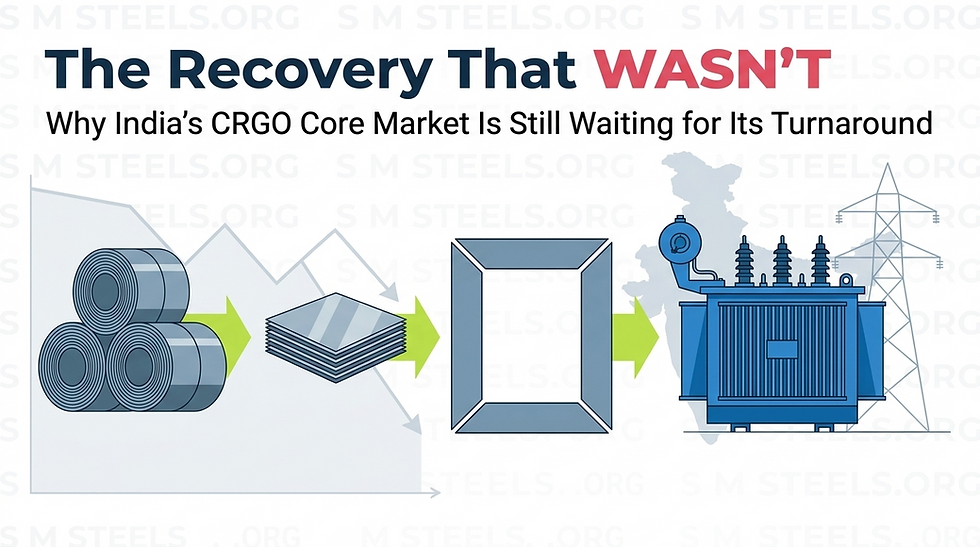
The journey from CRGO mother coil to functioning transformer core involves multiple steps, each adding value and requiring precision:
Mother coil arrives from mill (Japan, Korea, or domestic source) — typically 900–1,100 mm wide
Slitting — mother coil is slit into narrow coils at the width required by the transformer design
Cutting/Stamping — slit coils are cut into individual laminations of the required geometry (E-I, L, T, mitre, step-lap)
Annealing (stress relief) — cut laminations are annealed to relieve stresses introduced by cutting, which would otherwise degrade magnetic properties at the cut edges
Core assembly (stacking) — laminations are precisely stacked and interlocked to form the core, with careful attention to joint configuration and clamping pressure
Testing — assembled cores are tested for no-load loss and exciting current before winding
Each step in this chain is a potential source of performance degradation if not executed correctly. The quality of the CRGO material is necessary but not sufficient — the entire downstream process must maintain the material's properties.
8. Types of Core Losses CRGO Eliminates
Understanding what CRGO actually does inside a transformer requires understanding what core losses are and why they matter.
What Are Core Losses?
Core losses — also called iron losses or no-load losses — are the energy losses that occur in the magnetic core of a transformer every second it is energised, regardless of whether it is carrying any load. A transformer connected to the grid but powering nothing at 2 AM is still losing energy through its core. Over the 25–30 year life of a distribution transformer, these no-load losses represent a very significant portion of total energy consumed.
Core losses have two components:
1. Hysteresis Loss
Every time the alternating current in the transformer's primary winding reverses direction (100 times per second at 50 Hz — 50 forward cycles and 50 reverse cycles), the magnetic domains inside the core must flip their orientation to follow the changing magnetic field.
This domain reversal is not free. It requires energy to overcome the internal friction of the domain walls moving through the steel crystal structure. This energy is dissipated as heat. It is called hysteresis loss.
The magnitude of hysteresis loss depends on the material's coercive force — how hard it is to flip the domains. CRGO's aligned grain structure dramatically reduces coercive force in the rolling direction, meaning domains flip with far less energy expenditure than in random-grain steel.
Hysteresis loss is proportional to Bmax^1.6 × frequency, where Bmax is the peak magnetic flux density. This means that operating transformers at the correct flux density — and using CRGO grades that allow higher operating flux density without saturation — directly reduces hysteresis losses.
2. Eddy Current Loss
The alternating magnetic flux in the transformer core also induces voltage — and therefore circulating currents — within the steel itself. These circulating currents (eddy currents) flow through the steel and generate heat. This is eddy current loss.
CRGO attacks eddy current loss through two mechanisms:
Silicon content (~3.25%): Silicon dramatically increases the electrical resistivity of the steel — from approximately 10 micro-ohm-centimetres for pure iron to approximately 48 micro-ohm-centimetres for CRGO. Higher resistivity means that for the same induced voltage, less current flows, and therefore less power is wasted as heat. This is why every CRGO material specification includes a resistivity value of approximately 48 µΩ·cm.
Lamination (thin sheets): Eddy current loss is proportional to the square of the lamination thickness. Cutting a lamination from 0.35 mm (M6) to 0.23 mm (M3) reduces eddy current loss by approximately (0.35²/0.23²) = 2.31 times in the eddy current component. This is why thinner grades provide substantially lower total core loss, and why the trend in high-efficiency transformer design is always toward thinner laminations.
Eddy current loss is proportional to Bmax² × f² × t², where f is frequency and t is lamination thickness.
Total Core Loss in Practice
The best CRGO grades available today achieve core losses as low as 0.9 W/kg at 1.7 Tesla and 50 Hz for Hi-B grades. Conventional M-grade CRGO typically achieves 1.0–1.3 W/kg at 1.5 Tesla and 50 Hz depending on grade. By comparison, older non-oriented steels exhibited losses of 2–4 W/kg under the same conditions — a 2–4x improvement represents an enormous reduction in energy waste at national scale.
For a country like India, where hundreds of thousands of distribution transformers are energised continuously, the difference between M4-grade CRGO cores and substandard or wrong-grade materials translates to hundreds of millions of kilowatt-hours of energy saved or wasted annually. This is not a technical abstraction. It is a national energy efficiency issue.
9. CRGO vs CRNO — What Is the Difference?
CRNO stands for Cold Rolled Non-Oriented steel. It is also a silicon-iron electrical steel, also produced by cold rolling, but with a fundamental difference in its grain structure.
The Key Difference
Property | CRGO | CRNO |
Grain orientation | Highly aligned (Goss texture) | Random in all directions |
Magnetic permeability | Very high in rolling direction | Moderate and uniform in all directions |
Core loss | Very low | Higher than CRGO |
Magnetic properties | Strongly directional | Isotropic (same in all directions) |
Primary application | Transformer cores | Motors, generators, alternators |
Cost | Higher | Lower |
Why Transformers Need CRGO and Motors Need CRNO
In a transformer core, the magnetic flux travels in a fixed path — always in the same direction around the core. This is ideal for CRGO, which performs brilliantly in one direction.
In a motor or generator, the rotating magnetic field means the flux changes direction continuously as the rotor spins. CRGO would be at a disadvantage here because its properties are so directional — it would perform excellently in one orientation and poorly in the perpendicular direction. CRNO's isotropic (direction-independent) properties are better suited to this rotating-field application.
This fundamental difference means the two materials serve different but complementary roles in the electrical ecosystem — CRGO for the static power conversion in transformers, CRNO for the rotating machines that generate and use power.
10. Hi-B CRGO — The Advanced Grade
Beyond the standard M3–M6 grades, there is a higher performance class of CRGO known as Hi-B (High Permeability) grain-oriented electrical steel.
What Makes Hi-B Different
Hi-B steels achieve an even higher degree of grain orientation than conventional CRGO — approaching near-perfect Goss texture alignment. This is accomplished through:
Tighter process controls during secondary recrystallisation
In some products, laser scribing or mechanical scribing of the steel surface, which breaks up magnetic domain structures and reduces core loss without changing the grain orientation (domain-refined Hi-B)
Hi-B Performance
Hi-B grades are typically specified at 1.7 Tesla flux density rather than 1.5 Tesla used for conventional CRGO grades — reflecting their higher magnetic saturation capability. Popular Hi-B grades used in India include:
23ZDMH85 / 23ZDMH90 (0.23 mm)
27ZDMH90 / 27ZDMH95 (0.27 mm)
23ZH90 / 23ZH95 (0.23 mm Hi-B)
27ZH95 / 27M-OH (0.27 mm Hi-B)
Domain-refined CRGO can achieve up to 15% lower core loss than equivalent conventional CRGO grades, and up to 30% lower core loss than standard grain-oriented steel in some comparisons.
When India Needs Hi-B
India's Bureau of Energy Efficiency star rating mandate for distribution transformers — particularly the push toward 4-star and 5-star rated transformers — is driving increased demand for Hi-B grades. The BEE's upgraded efficiency requirements from January 2025 onward mean that transformer manufacturers who were previously specifying M5 or M6 are being pushed toward M4 and Hi-B materials to meet the new loss benchmarks.
11. CRGO Material Properties — Technical Specifications
For engineers, procurement professionals, and quality teams, the following technical parameters define CRGO material quality:
Physical Properties
Property | Value |
Steel Density | 7.65 g/cm³ |
Silicon Content | ~3.10–3.25% |
Electrical Resistivity | ~48 µΩ·cm |
Carbon Content (after decarburisation) | ≤ 0.005% |
Mechanical Properties
Property | Value |
Ultimate Tensile Strength (parallel to rolling) | ~32.6 kg/mm² |
Ultimate Tensile Strength (perpendicular to rolling) | ~38.2 kg/mm² |
Yield Strength | Lower in rolling direction (by design) |
Thickness and Tolerances (per JIS C 2553 / JIS C 3553)
Standard commercial thicknesses:
0.20 mm (0.0079 in.) — specialty applications
0.23 mm (0.0091 in.) — M3 grade
0.27 mm (0.0106 in.) — M4 grade
0.30 mm (0.0118 in.) — M5 grade
0.35 mm (0.0138 in.) — M6 grade
Thickness tolerances are extremely tight — typically ±0.02 mm or better — because thickness directly affects both eddy current losses and the stacking factor calculations used in core design.
Magnetic Properties
Transformer manufacturers and core designers require the following magnetic data from CRGO suppliers:
Core loss (W/kg) at specified flux densities (1.5 T for conventional, 1.7 T for Hi-B) and 50 Hz
Magnetic induction (B800 or B2500) — the flux density achieved at specified magnetising force (H)
Exciting current (VA/kg) — the reactive power required to magnetise the core
These values are provided as guaranteed maximum values by the mill for each grade and thickness, and independently verified by reputable suppliers. Mills also provide curves of core loss and AC magnetisation at various flux densities — essential for transformer designers.
Standards Reference
CRGO is covered by major international standards:
JIS C 2553 (Japan) — the most widely referenced in India
ASTM A876 (USA)
IEC 60404-8-7 (International)
DIN EN 10107 (Germany/Europe)
IS 3024 (India — BIS standard for CRGO)
The Quality Control Order (QCO) implemented by BIS in 2020 mandates that all CRGO used in India must comply with IS 3024 and carry BIS certification — applicable to both domestic production and imports.
12. CRGO and India's Power Sector — The Real Picture
India's transformer market is one of the most dynamic in the world. As of 2024, the Indian transformer market was valued at approximately $5.1 billion, on a steep growth trajectory driven by:
India's 500 GW renewable energy target by 2030 — requiring massive new transmission and distribution infrastructure
Grid expansion and modernisation — particularly at the 220 kV and 765 kV levels
The PM Surya Ghar and rural electrification programmes
Data centre construction — India is attracting data centre investment at scale, each requiring dedicated power infrastructure
Industrial expansion — manufacturing, logistics, and urban infrastructure growth
India added an impressive 86,433 MVA of transformation capacity in 2024–25 — 22.2% higher than the previous year. As of March 2025, the AC transformation capacity at 220 kV and above stood at approximately 1,304 GVA, growing at a CAGR of approximately 5.82% since 2018–19.
Every megavolt-ampere of that transformation capacity runs through a transformer. Every transformer requires a CRGO core. The connection between India's energy ambitions and the CRGO supply chain is not incidental — it is structural and inescapable.
13. India's CRGO Import Dependency — The Strategic Problem
The Supply Gap in Numbers
India is one of the world's largest consumers of CRGO steel. The numbers reveal a structural vulnerability that the industry cannot ignore:
FY2024 total CRGO demand: approximately 400,000 tonnes
Domestic production: approximately 50,000 tonnes (~12.5% of demand)
Imports: approximately 239,200 tonnes (from China, Japan, Russia, South Korea)
Available for local use: approximately 277,800 tonnes (after exports)
Shortfall: approximately 122,200 tonnes — a 30.6% deficit
India's domestic production currently meets only 10–12% of its own CRGO demand. The remaining 88–90% is imported.
Where India Imports CRGO From
The major origin countries for India's CRGO imports are:
Japan — the historically dominant supplier, home to Nippon Steel and JFE Steel, producers of some of the world's finest CRGO grades
South Korea — POSCO is a major global CRGO producer
China — increasingly significant, with Chinese capacity expanding rapidly. China's CRGO exports surged from 494,800 mt in 2023 to 666,300 mt in 2024, a 34.7% year-on-year increase. India is one of China's primary export destinations.
Russia — an emerging source, gaining ground particularly as Russian CRGO is priced competitively and not subject to the same duty complications as some other origins in certain markets
The BIS Certification Bottleneck
All CRGO imported into India must be certified by the Bureau of Indian Standards (BIS) under the Quality Control Order (QCO) mandated in 2020. The QCO was implemented with good intent — to ensure quality standards — but its implementation has created a significant supply bottleneck.
Delayed license renewals by BIS for foreign suppliers from Japan, South Korea, and China have created periods of import uncertainty that sent prices spiking and constrained supply precisely when India's transformer manufacturing demand was growing. The GTRI (Global Trade Research Initiative) report from 2024 specifically called out this bottleneck as an immediate cause of the CRGO shortage.
The Domestic Production Gap
India has approximately one primary domestic CRGO producer at scale, and the JSW Steel expansion into CRGO production represents a significant planned increase in domestic capacity. However, building a CRGO production facility capable of manufacturing 100,000 tonnes per year requires an investment of approximately USD 400–600 million — and the technology involves some of the most complex metallurgical processes in the steel industry.
The lead times involved in building capacity, qualifying product grades with transformer manufacturers, and achieving consistent production quality mean that domestic supply relief is a medium-to-long-term solution, not an immediate one.
India's CRGO demand is projected to grow at 10–12% annually through 2030. Without significant expansion in both domestic production and import streamlining, the supply gap will widen.
Why This Matters Beyond Economics
CRGO is now recognised as a strategic material for India's energy transition. Without adequate CRGO supply:
Transformer manufacturing timelines extend
Transformer prices rise — affecting DISCOM procurement budgets
India's ability to meet its 500 GW renewable energy integration target is compromised
India's emerging transformer export competitiveness is undermined
The CRGO supply chain is not a commodity logistics problem. It is a national energy security question.
14. BEE Star Rating and CRGO — What Changed in 2025
India's Bureau of Energy Efficiency introduced a star rating programme for distribution transformers — similar to the star ratings that exist for appliances like air conditioners and refrigerators. Transformers are classified on a 1-star to 5-star scale, with 5-star being the most efficient.
From January 1, 2025, the BEE mandated an upgrade to the star rating requirements — effectively raising the efficiency bar for all distribution transformers sold in India. Transformers that previously qualified for a 3-star rating under old norms now need to achieve what was previously a 4-star standard.
The CRGO Implication
The star rating is determined primarily by no-load losses (core losses) and load losses at 50% and 100% of full load. To achieve higher star ratings, manufacturers must reduce core losses. The most direct and impactful way to reduce core losses is to use higher-grade CRGO — moving from M5 to M4, or from M4 to M3 or Hi-B grades.
The BEE mandate has therefore created a structural shift in CRGO demand toward higher grades (M3, M4, Hi-B) and away from M5 and M6. This grade shift is important for procurement teams to understand: not only is total CRGO demand growing, but the mix is shifting toward more expensive, higher-performance grades. The implications for pricing, availability, and supplier qualification are significant.
Transformers are tested and classified based on:
No-load loss (Watts) — directly linked to CRGO core quality and grade
Load loss (Watts) at 50% and 100% load — linked to winding design and conductor choice
Total loss at each load point — the sum determines the star rating
15. Where CRGO Is Used Beyond Transformers
While transformers are by far the largest application for CRGO core material, it is also used in several other applications where static, directional magnetic flux and low core loss are required:
Power and Distribution Transformers
The primary application. Covers:
Distribution transformers (25 kVA to 2,500 kVA) — the most numerous transformers in India's grid
Power transformers (above 5 MVA) — used at substations for stepping voltage up and down in the transmission network
Extra-high-voltage transformers (220 kV, 400 kV, 765 kV) — the backbone of India's interstate grid
Instrument Transformers
Current transformers (CTs) and potential transformers (PTs) used for metering and protection use CRGO cores, often in wound or toroidal configurations.
Shunt Reactors
Large shunt reactors used in high-voltage transmission lines for reactive power compensation use CRGO cores.
Static Reactors and Inductors
Industrial inductors and reactors in power quality equipment, static VAR compensators, and similar applications.
Large Generators
The stators of very large generators sometimes use grain-oriented steel in specific configurations to take advantage of CRGO's directional properties in the regions where flux flow is predominantly unidirectional.
16. Buying CRGO in India — What to Know
Forms Available in the Indian Market
CRGO is traded in India in several forms, each serving different buyers in the supply chain:
Mother Coils (Primary Coils) Large coils as received from the mill — typically 900–1,100 mm wide, several tonnes per coil. Purchased by slitting facilities and large transformer manufacturers with in-house processing capability.
CRGO Slit Coils Mother coils slit to narrower widths specified by the buyer's core design. The most common form in which transformer manufacturers and core cutting facilities purchase CRGO. Width tolerances and edge quality are critical parameters.
CRGO Secondary Sheets Sheets from off-specification or secondary-grade material — either from production overruns, edge trim, or material that does not meet prime specifications. Used by cost-conscious buyers for less critical applications. The secondary market is a significant part of India's CRGO trading ecosystem, providing cost-effective material for specific applications.
CRGO Scrap Scrap CRGO arising from lamination cutting, punching, and slitting operations. Traded separately and used in specific recycling and secondary steel applications.
What to Evaluate When Sourcing CRGO
For transformer manufacturers and core cutting facilities, the following parameters matter in procurement:
Grade and thickness — confirmed by mill test certificates
Mill of origin — Japanese, Korean, or domestic origin materials each have established performance track records in the Indian market
BIS certification status — essential for compliance with the QCO
Slitting quality — width tolerance, edge burr, and surface condition
Coil weight and ID/OD dimensions — must suit the buyer's processing equipment
Core loss and magnetic induction values — from mill test certificates, not just grade labels
Supplier inventory position — availability and lead time, particularly important during supply-tight periods
The Importance of a Knowledgeable Supply Partner
Given the complexity of CRGO procurement — grade selection, origin qualification, BIS compliance, price cycle navigation, and quality verification — the choice of supply partner is not simply a price decision. A supplier who understands the market, maintains reliable inventory across grades, and provides accurate material documentation is a supply chain asset, not merely a vendor.
For transformer manufacturers, procurement teams, and core cutting facilities across India, SM Steels operates as a specialist CRGO core material supplier in India, with deep market knowledge and a consistent inventory position across grades and forms.
17. Frequently Asked Questions
Q: What does CRGO stand for? A: CRGO stands for Cold Rolled Grain Oriented. It refers to a type of electrical steel — a silicon-iron alloy — whose internal grain structure has been precisely aligned through a controlled manufacturing process to optimise magnetic properties in the rolling direction.
Q: What is CRGO used for? A: CRGO is used primarily as the core material in electrical transformers — both distribution transformers and power transformers. It is also used in instrument transformers, shunt reactors, and certain large generators. In every application, its role is to provide a low-loss magnetic path for alternating magnetic flux.
Q: Why is CRGO used in transformers specifically? A: Transformers require a core material with high magnetic permeability (to carry flux efficiently), low core loss (to minimise energy waste as heat), and durability over decades of continuous operation. CRGO's aligned grain structure gives it the highest magnetic permeability in the rolling direction of any commercially available steel, combined with low hysteresis and eddy current losses due to its grain orientation and silicon content.
Q: What is the difference between CRGO and CRNO? A: CRGO (Cold Rolled Grain Oriented) has grains aligned in one direction — ideal for transformer cores where flux flows in a fixed path. CRNO (Cold Rolled Non-Oriented) has randomly oriented grains — better suited for motors and generators where the magnetic field rotates. CRGO has lower core loss and higher permeability in the rolling direction; CRNO has more uniform (but generally lower) properties in all directions.
Q: What are M3, M4, M5, M6 grades of CRGO? A: These are the standard commercial grades of CRGO, differing in thickness and core loss level. M3 (0.23 mm) is the thinnest and most efficient; M6 (0.35 mm) is the thickest and most economical. Lower grade number = thinner steel = lower core loss = higher efficiency = higher cost.
Q: What is a CRGO lamination? A: A CRGO lamination is a thin, individually insulated sheet of CRGO steel, cut to a specific geometry and stacked with other laminations to form a transformer core. The thin lamination (0.23–0.35 mm) and the insulation between sheets reduce eddy current losses by confining induced currents to a small cross-section.
Q: What is Hi-B CRGO? A: Hi-B (High Permeability) CRGO is an advanced grade of grain-oriented electrical steel with an even higher degree of grain alignment than conventional CRGO. It achieves lower core losses and can operate at higher flux densities (1.7 Tesla vs 1.5 Tesla for conventional grades). Domain-refined Hi-B — treated by laser scribing — can achieve up to 15–30% lower core loss than conventional grades.
Q: How much CRGO does India import? A: In FY2024, India imported approximately 239,200 tonnes of CRGO, with domestic production of approximately 50,000 tonnes — meeting only about 10–12% of total demand of approximately 400,000 tonnes. This represents a strategic import dependency from Japan, South Korea, China, and Russia.
Q: What is the Goss texture in CRGO? A: The Goss texture, denoted {110}<001> in crystallographic notation, is the specific grain orientation achieved in CRGO steel through controlled cold rolling and secondary recrystallisation annealing. It was discovered by Norman P. Goss in 1934. In this orientation, the crystal's easy axis of magnetisation (the <001> direction) is aligned with the rolling direction, giving CRGO its exceptional magnetic properties in that direction.
Q: What is the silicon content of CRGO? A: CRGO contains approximately 3.0–3.25% silicon by weight. Silicon is critical because it increases the electrical resistivity of the steel from ~10 µΩ·cm (pure iron) to ~48 µΩ·cm, directly reducing eddy current losses. Higher silicon content would improve resistivity further but makes the steel too brittle for cold rolling.
Q: Does CRGO core quality affect transformer efficiency? A: Directly and significantly. The grade of CRGO core material determines the no-load (core) losses of the transformer — losses that occur every second the transformer is energised, regardless of load. A transformer with M4-grade CRGO will have measurably lower core losses than the same design with M6 CRGO, saving energy continuously over its 25–30 year operational life. India's BEE star rating system for distribution transformers directly evaluates and classifies transformers based on these losses.
Conclusion
CRGO — Cold Rolled Grain Oriented steel — is not simply a raw material. It is the precision-engineered foundation upon which India's entire transformer manufacturing industry, and by extension its power distribution infrastructure, is built.
From the Goss texture discovered in 1934 to the 400,000 tonnes India needs annually to keep its grids energised, the story of CRGO is the story of electrical civilisation at industrial scale.
Understanding what CRGO is, how it works, why its grades matter, and why India's supply chain for it is strategically vulnerable is not merely technical knowledge. It is essential intelligence for anyone operating in the transformer manufacturing ecosystem, the electrical infrastructure supply chain, or India's energy sector.
The CRGO core is where electricity becomes power. And in India's energy story, it is where ambition meets material reality.
About SM Steels — CRGO Core Material Supplier in India
S M Steels is a Chennai-based specialist trader and supplier of CRGO core material, operating at the centre of India's electrical steel supply chain. With deep market knowledge across grades, origins, and forms — from CRGO coils and secondary sheets to CRGO scrap — S M Steels serves transformer manufacturers, core cutting facilities, and procurement teams across India.
For sourcing support, grade availability, or market intelligence on CRGO procurement, connect with S M Steels — India's trusted CRGO core material supplier.
📍 S M Steels, Chennai 🌐 www.smsteels.org 📞 Contact Us
We don't just supply CRGO. We understand it.


Comments