


The Recovery That Wasn't: Why India's CRGO Core Market Is Still Waiting for Its Turnaround

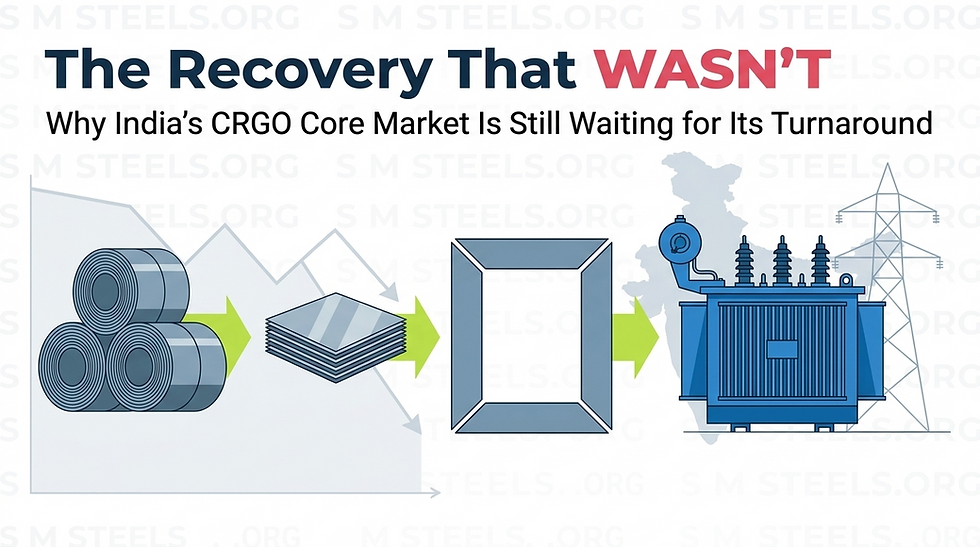
There was a broad consensus heading into late 2025: the CRGO market would correct, absorb the shock, and stabilise by Q4. Traders were holding inventory with that expectation. Procurement teams had pencilled in budget revisions. Even cautious buyers were signalling intent to re-enter the market by December.
That recovery didn't arrive.
And what's more telling than the delay itself is the silence around it. Nobody in the supply chain wants to publicly admit that the fundamentals they were betting on — falling import prices, rising transformer demand, policy-backed procurement — haven't aligned the way the market needed them to.
This isn't a temporary blip. It is a structural misread. And it deserves to be examined without the usual optimism that tends to accompany industry commentary on India's power infrastructure story.
The Big Picture That Sets the Stage
India's power sector narrative remains compelling on paper. The country is in the middle of an unprecedented infrastructure push — transmission line expansions, renewable energy integration targets, data centre corridors, and urban grid upgrades are all running simultaneously. The government's own projections have pointed to transformer demand growing significantly through 2026 and beyond.
All of that is real. The demand pipeline exists.
But demand pipelines and procurement realities are two very different things. And the gap between them is exactly where the CRGO core market is currently stuck.
Transformer manufacturers — the primary consumers of CRGO core material — have not been placing orders at the volumes the market anticipated. Utility procurement, particularly from state DISCOMs, has remained patchy. And the financing cycles that drive large transformer orders have been slower to move than the headline investment numbers suggest.
The Hidden Problem: A Multi-Layered Stall
The surface explanation for the sluggish recovery is pricing. Import prices from Japan, South Korea, and increasingly from other origins have not softened to the degree buyers were hoping for. The expectation was that a global demand cooldown would translate into more competitive landed costs in India. That has only partially materialised.
But pricing is only one layer.
Beneath it, there are at least three structural issues that are quietly keeping the market from finding its footing:
One — Inventory Overhang That Won't Clear
When prices were rising sharply, a section of traders and mid-tier transformer manufacturers built inventory positions based on forward demand assumptions. Those assumptions have not been validated at the pace required. The result is that secondary market activity has slowed considerably. Buyers who might otherwise have picked up spot material are holding back, knowing that distressed inventory is sitting in the system and may come at a discount if they wait.
Market participants report that secondary sheet movement in particular has been sluggish, with some traders absorbing carrying costs well beyond what they had planned for.
Two — DISCOM Procurement Has Not Delivered
The transformer demand thesis was heavily anchored on state utility ordering. Large distribution and transmission transformer tenders were expected to flow through in volume by mid-to-late 2025. Some did. Many didn't — or were delayed, revised, or broken into smaller tranches that reduced the immediate pull on CRGO core material.
When DISCOM orders move slowly, the entire upstream chain feels it. Transformer manufacturers don't commit to raw material procurement without confirmed order books. And without that commitment, CRGO traders have no cover to move their positions.
Three — Domestic Supply Has Added Complexity, Not Relief
There has been much discussion about JSW Steel's expansion into CRGO production and what it means for India's import dependency. In principle, a domestic source of CRGO should add stability to the market. In practice, the transition period has introduced its own complexity.
Buyers are navigating questions around grade availability, consistency, and pricing parity with imported material. Some transformer manufacturers have been cautious about switching specifications mid-cycle. The domestic supply option has not yet become the market anchor it was expected to be — and in the interim, it has contributed to a wait-and-watch posture rather than active procurement.
The CRGO Core Connection: Where It All Converges
CRGO core material sits at the centre of this entire chain. Every transformer built — whether it's a 25 kVA distribution unit or a 100 MVA power transformer — requires a precision-engineered CRGO core. There is no substitution. There is no workaround.
Which is precisely why the market's stall is so significant.
When procurement slows at the transformer manufacturer level, CRGO coils stop moving. When coils stop moving, secondary sheet markets soften. When secondary markets soften, CRGO secondary sheets pile up in trader inventory. And when inventory builds without a clear offtake horizon, pricing signals become distorted — neither reflecting true replacement cost nor offering the discount deep enough to trigger aggressive buying.
The CRGO core market is, in effect, caught between a real demand story that exists in policy documents and a procurement reality that is moving far slower than those documents imply.
Ground-Level Market Reality: What Traders Are Actually Experiencing
This is where the industry commentary often falls short — at the level of what is actually happening in daily trade.
Reports from market participants paint a consistent picture:
Buyers are not absent. They are present, negotiating, and then stepping back. The intent exists, but the conviction to commit at current price levels does not.
Procurement teams at mid-sized transformer manufacturers are operating with tighter working capital than a year ago. Even where order books exist, financing constraints are causing delays in raw material sourcing.
The spot market for CRGO scrap and secondary material has seen inconsistent pricing — some weeks showing marginal recovery, followed by softening — without establishing any directional trend that would give traders confidence to reposition.
Several traders who were expecting a Q4 2025 recovery have extended their holding horizon into Q1 2026, absorbing interest costs and watching margins compress.
Imported material pricing has remained sticky on the downside. Suppliers in origin countries have shown little urgency to aggressively discount, partly because their own order books from other geographies have provided some cushion.
None of this is catastrophic. But it is the quiet erosion that doesn't show up in press releases or sector reports — and it is shaping real business decisions right now.
What's Being Done vs. What's Still Missing
On the positive side, there are genuine structural tailwinds that will eventually matter:
The PM Surya Ghar scheme and broader solarisation of the distribution network will drive transformer demand, including at the distribution level.
Data centre investment — which India is attracting at scale — requires power infrastructure that runs through transformers and therefore through CRGO core.
The government's stated intent to reduce import dependency in critical electrical components remains a policy priority, even if execution is uneven.
What's missing, however, is the connective tissue between these macro drivers and ground-level procurement:
DISCOM financial health remains uneven across states. Without creditworthy utility buyers, transformer manufacturers cannot confidently build order books.
There is no effective price discovery mechanism for CRGO core in the Indian market. Prices are largely determined by import cost, trader margin, and negotiation — without the transparency that would help buyers and sellers find equilibrium faster.
The domestic production narrative needs more clarity. Market participants need clearer signals on availability, grade mix, and pricing from domestic sources before they can restructure their procurement strategies accordingly.
Forward Outlook: Waiting for the Trigger
The CRGO core market will recover. That is not in question. The demand fundamentals for transformers in India over the next decade are structurally sound.
The question is what triggers the next active procurement cycle — and when.
The most likely catalyst is a concentrated burst of DISCOM ordering, potentially driven by state elections creating political urgency around rural electrification and grid reliability. When that happens, it tends to compress lead times rapidly and push transformer manufacturers into the market for raw materials simultaneously.
When that moment arrives, traders carrying inventory will see a sharp reversal. Those who stepped out of the market during the stall will face price and availability pressure.
Industry estimates suggest that a demand recovery of even moderate intensity could absorb the current inventory overhang within two to three quarters, potentially tightening the market faster than most current forecasts anticipate.
The risk is in waiting too long to reposition — and finding the market has moved before the procurement decision has been made.
Conclusion
The CRGO market's delayed recovery isn't a mystery. It's the predictable outcome of a demand story built on policy intent colliding with procurement systems that move slowly, inconsistently, and under financial pressure.
The traders and manufacturers who navigate this period well will not be those who waited for certainty. They will be those who understood the structure of the stall — and positioned accordingly.
The recovery isn't missing. It's just not moving on anyone's schedule but its own. Looking to navigate the CRGO market with better intelligence?
SM Steels has been operating at the centre of India's CRGO supply chain for years — tracking price movements, managing inventory cycles, and supplying transformer manufacturers across the country with CRGO core material, CRGO coils and secondary sheets.
If you're a transformer manufacturer, trader, or procurement professional trying to make sense of where the market is heading — or looking for a reliable supply partner who understands the ground reality — we're worth a conversation.
📍 S M Steels 🌐 www.smsteels.org 📞+91 89394 61720
We don't just supply CRGO. We track it, analyse it, and move with the market — so our customers don't have to guess.


Comments