


CRGO Electrical Steel: Why India Needs a Specialised Policy Approach for Power Infrastructure


Strengthening domestic manufacturing while ensuring uninterrupted access to certified prime CRGO coils
India's power sector is entering a period of significant expansion. Transmission infrastructure is being strengthened, renewable-energy capacity is increasing, electric mobility is accelerating, and the rapid development of data centres and digital infrastructure is creating new electricity demand.
At the centre of much of this infrastructure is a highly specialised material that receives comparatively little public attention: Cold Rolled Grain Oriented Electrical Steel, or CRGO.
CRGO is the magnetic core material used in power and distribution transformers. Its electrical and magnetic properties directly influence transformer efficiency and no-load losses. Unlike conventional structural or commodity steel, CRGO is a specialised electrical steel manufactured to tightly controlled magnetic, dimensional and surface-performance requirements.
This distinction is important when considering India's policy framework for the material.
India has taken several important steps to build domestic CRGO manufacturing capability. At the same time, the country continues to depend heavily on imported prime CRGO coils. The policy challenge, therefore, is not a choice between domestic manufacturing and imports. It is how India can build domestic capacity while maintaining reliable access to quality-assured CRGO during the transition period.
India remains significantly dependent on imported CRGO
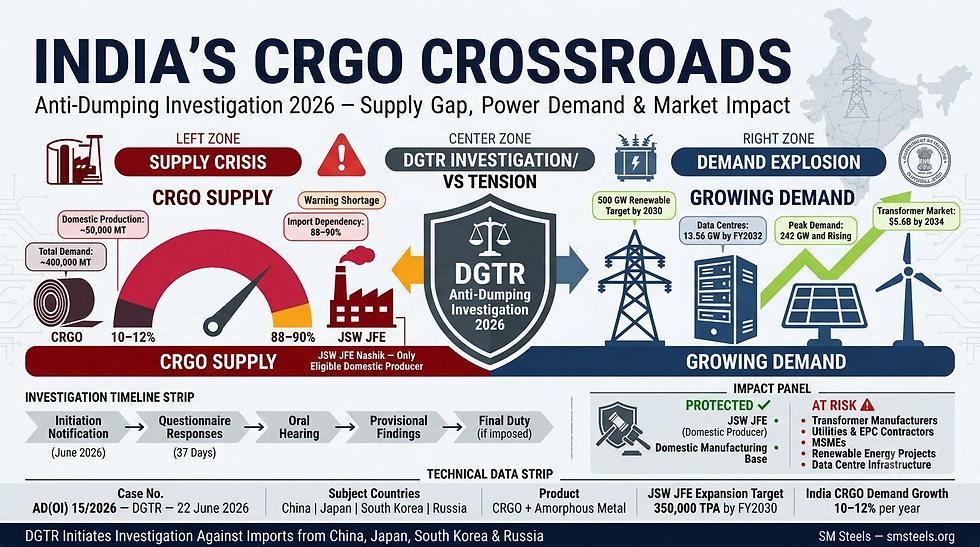
Recent estimates cited by the Global Trade Research Initiative (GTRI) put India's annual CRGO consumption at approximately 400,000–450,000 tonnes, while domestic production has been estimated at only 40,000–50,000 tonnes. This means that close to 90% of India's requirement continues to be met through imports. (energy.economictimes.indiatimes.com)
This import dependence is not simply a result of a lack of conventional steelmaking capacity. CRGO is a technologically specialised electrical steel requiring specific manufacturing processes and quality control.
The Bureau of Indian Standards currently lists IS 3024:2015 for grain-oriented electrical steel sheet and strip, and CRGO is covered under the compulsory certification framework. (bis.gov.in)
The quality-control framework serves an important purpose. It helps ensure that material entering the transformer manufacturing chain meets the required Indian standards.
The challenge arises when the number of certified and available overseas sources becomes constrained while domestic production is still substantially below national consumption.
The BIS factor and the importance of continuity of supply
India's CRGO import framework has been shaped by the requirement that the material comply with applicable BIS standards and certification requirements.
The industry experienced a significant supply disruption during 2024. An industry record from the Indian Transformer Manufacturers Association (ITMA), documenting an inter-ministerial meeting on CRGO scarcity, stated that renewal of BIS licences for four Chinese mills had been kept on hold, with the mills representing approximately 22% of India's CRGO requirement at that time. The same record also referred to delays involving a Korean supplier. (itma.org.in)
The resulting shortage highlighted an important policy lesson: when domestic production is not yet sufficient, administrative interruptions affecting certified overseas supply can have consequences far beyond the steel industry itself.
The objective of BIS certification—ensuring quality and reliability—remains essential. The question is whether the certification and renewal mechanism for specialised imported electrical steel can be made sufficiently predictable and responsive to the realities of India's power-sector demand.
A faster and more transparent renewal pathway for compliant foreign manufacturers, while retaining all necessary quality checks, could help reduce avoidable supply disruptions.
Domestic CRGO manufacturing is expanding
There is encouraging progress on the domestic manufacturing side.
JSW Steel, through its partnership with JFE Steel, currently has a CRGO facility in Nashik with approximately 50,000 tonnes per annum of capacity. The company has announced plans to expand the Nashik facility to 250,000 tonnes per annum and develop 100,000 tonnes per annum of capacity at Vijayanagar, taking the targeted combined capacity to approximately 350,000 tonnes per annum. JFE has stated that the Vijayanagar facility is targeted for operation by 2027, with the Nashik expansion scheduled in phases between 2028 and 2030. (jswsteel.in)
This is a major positive development for India's electrical-steel ecosystem.
The Government has also recognised the strategic importance of electrical steel. CRGO is included within the Specialty Steel PLI framework, demonstrating that domestic manufacturing of this specialised material is already being treated as an area worthy of policy support. (ddnews.gov.in)
However, the transition period remains important.
Until the announced capacity becomes operational at scale, there is a substantial difference between India's current domestic production and total requirement.
That gap cannot simply disappear because new capacity has been announced.
India's electricity infrastructure is expanding rapidly
The requirement for transformers is closely connected to India's broader power-infrastructure programme.
According to the Ministry of Power, the National Electricity Plan envisages the addition of approximately 1,91,474 circuit kilometres of transmission lines and 1,274 GVA of transformation capacity between 2022-23 and 2031-32at 220 kV and above. By 2031-32, total transformation capacity at these voltage levels is projected to reach approximately 2,345 GVA. (powermin.gov.in)
The Ministry of Power has also acknowledged that transformer and reactor supply depends on key components including CRGO steel, bushings, insulation and copper conductors, and that supply-chain constraints in these components have been observed. The Ministry stated in March 2026 that the transformer industry is undertaking substantial capacity expansion, with approximately 315 GVA of additional manufacturing capacity planned over three years. (powermin.gov.in)
This makes the availability of CRGO more than a specialised steel-industry issue.
It is ultimately an infrastructure issue.
The impact reaches the final transformer price
CRGO is one of the major raw materials in transformer manufacturing.
The Central Electricity Authority itself describes the core material—CRGO or amorphous steel—as accounting for a major portion of transformer material cost, and notes that shortages and price fluctuations can hamper timely transformer supply. (cea.nic.in)
Industry estimates can vary depending on transformer rating, design, efficiency class, copper or aluminium winding, and other specifications. The precise percentage therefore differs from one transformer to another.
But the principle is straightforward:
When the cost or availability of CRGO changes materially, the effect does not stop at the CRGO supplier. It moves through the transformer manufacturer's cost structure and ultimately influences the price at which the transformer can be supplied.
This becomes particularly important when transformers are procured through competitive government and utility tenders.
A transformer manufacturer cannot simply absorb a substantial and unexpected increase in a critical raw material indefinitely. At the same time, a utility procurement process is designed around competitive pricing and project budgets.
The result can be a difficult balance between:
competitive tender pricing;
transformer manufacturers' actual input costs;
project execution timelines;
availability of compliant CRGO;
and ultimately the cost of expanding India's power infrastructure.
The Ministry of Power has itself recognised the importance of price variation mechanisms in long-duration power-sector contracts, while IEEMA maintains price-variation mechanisms specifically covering CRGO-related inputs. (powermin.gov.in)
Therefore, CRGO availability and pricing have a direct relevance to the economics of finished transformers supplied to utilities and government-linked projects.
Demand is likely to broaden beyond traditional power projects
India's future electricity requirement is not being driven by a single sector.
The International Energy Agency expects India's electricity demand to grow at an average 6.4% annually through 2030, adding more than 570 TWh of annual consumption over the next five years. Industry, transport electrification and other expanding electricity uses are expected to contribute significantly to this growth. (iea.org)
Electric mobility
The Government's PM E-DRIVE programme is accelerating electric mobility. The Ministry of Heavy Industries' dashboard recorded more than 31 lakh EV sales across the scheme's reported categories as of August 2026, while the programme itself has been designed to support the adoption of electric vehicles across multiple segments. (pmedrive.heavyindustries.gov.in)
Greater electrification means greater demand for electricity infrastructure, charging infrastructure and associated grid investment.
Data centres and digital infrastructure
The growth of data centres adds another emerging source of electricity demand.
The Ministry of Electronics and Information Technology reported that India's data-centre capacity increased from approximately 375 MW in 2020 to around 1,500 MW in 2025. (pib.gov.in)
Wood Mackenzie estimates that India's operational data-centre capacity could rise from 2.2 GW in 2025 to 12 GW by 2030, driven by AI, cloud computing and the digital economy. (woodmac.com)
These developments are not themselves CRGO projects. However, they represent additional drivers of electricity demand and grid investment—and therefore contribute to the broader requirement for reliable electrical infrastructure.
A useful lesson from India's solar industry
A recent development in the solar industry provides an interesting example of how policy transition can be approached constructively.
In June 2026, industry associations from Karnataka, Kerala and Tamil Nadu approached the Karnataka High Court regarding the implementation of ALMM List-II for solar cells.
Importantly, the issue was not simply opposition to domestic manufacturing.
The industry bodies sought greater transition flexibility because of concerns regarding domestic availability, quality, pricing and the ability of existing projects to adapt immediately to the new sourcing requirement. (now.solar)
The Government subsequently provided a limited extension until 31 December 2026 for certain net-metering and open-access renewable-energy projects, rather than abandoning the domestic manufacturing objective. (mnre.gov.in)
The broader lesson is relevant to CRGO:
Domestic manufacturing goals and temporary supply-chain flexibility do not necessarily have to be opposing objectives.
A phased approach can allow domestic manufacturing to grow while ensuring that infrastructure projects already dependent on a constrained supply chain are not unnecessarily disrupted.
CRGO should be viewed differently from conventional steel categories
This is perhaps the most important policy consideration.
CRGO is a specialised electrical steel with a direct relationship to the efficiency and performance of transformers. Transformers, in turn, are fundamental to transmission, distribution, renewable-energy integration, industrial electrification and the expansion of India's electricity network.
Therefore, CRGO should not be assessed solely through the conventional lens of a general steel commodity.
A shortage of construction steel may affect construction costs.
A shortage of CRGO can affect the manufacture and delivery of equipment that is required to transmit and distribute electricity itself.
That distinction deserves specialised policy attention.
A balanced policy approach could support both Make in India and energy security
India's long-term objective of developing domestic CRGO manufacturing is important and should continue.
At the same time, until domestic capacity is sufficient to meet national requirements, a few targeted measures could help maintain supply continuity without compromising quality standards.
1. Faster BIS renewal for compliant overseas manufacturers
Existing compliant foreign manufacturers could have a more predictable and time-bound renewal mechanism, particularly where there is demonstrable domestic supply shortage.
This need not mean lowering the BIS standard.
It would mean improving administrative continuity while retaining technical scrutiny.
2. Wider access to qualified international sources
India could continue expanding the pool of approved foreign manufacturers and grades where they meet Indian technical requirements.
A diversified source base reduces dependence on any single country or manufacturer.
3. A transition mechanism until domestic capacity scales up
Where domestic production is demonstrably below national requirement, a clearly defined transitional import framework for certified prime CRGO coils could help bridge the gap until announced domestic capacity becomes operational.
Such a framework could retain traceability, testing and certification requirements.
4. Consider downstream impact in trade-remedy decisions
DGTR initiated an anti-dumping investigation in June 2026 covering CRGO and amorphous metal imports from China, Japan, Korea and Russia. The investigation remains ongoing as of August 2026; no final finding should be assumed at this stage. (dgtr.gov.in)
Given the importance of CRGO to transformers, it is valuable for the downstream impact on transformer manufacturers, utilities, grid projects and electricity infrastructure to be carefully considered alongside the interests of domestic electrical-steel manufacturing.
5. A dedicated CRGO policy mechanism
Considering its strategic role, CRGO could benefit from a more coordinated mechanism involving the relevant stakeholders across the Ministry of Steel, BIS, Ministry of Power, CEA, DGTR and industry representatives.
This would allow changes relating to certification, imports, domestic capacity, trade remedies and power-sector demand to be evaluated together rather than independently.
The objective should be resilience, not dependence
India's goal should ultimately be a resilient CRGO ecosystem with strong domestic manufacturing capability, technological development and multiple reliable sources of supply.
Domestic manufacturing will play an increasingly important role in achieving that objective.
But until the domestic capacity gap is closed, access to certified international supply remains an important part of India's energy-security equation.
The answer does not have to be a choice between imports and domestic manufacturing.
India can simultaneously encourage domestic CRGO production, maintain stringent quality standards, diversify international sourcing and create a predictable transition framework for certified prime CRGO coils.
That would support the interests of domestic electrical-steel manufacturing while also protecting the transformer industry and the much larger infrastructure programme that depends on it.
Conclusion
India is building an electricity system for a significantly more electrified economy.
Renewable-energy integration, transmission expansion, electric mobility, industrial growth and the rise of data centres are all increasing the importance of reliable power infrastructure.
Transformers sit at the heart of that infrastructure—and CRGO sits at the heart of the transformer.
With annual CRGO requirements estimated at 400,000–450,000 tonnes against current domestic production of approximately 40,000–50,000 tonnes, India remains in a transition period. At the same time, major domestic capacity expansion is underway, including the targeted 350,000-tonne-per-year JSW-JFE programme. (energy.economictimes.indiatimes.com)
This creates an important policy window.
The objective should be clear: build domestic capability, maintain quality, ensure supply continuity and keep India's transformer and power-infrastructure expansion economically viable.
A carefully calibrated policy approach can help achieve all four.

Comments